


夜线
NE Chhina's Shenyang rolls out two TIR cross-border routes_我的网站

A |
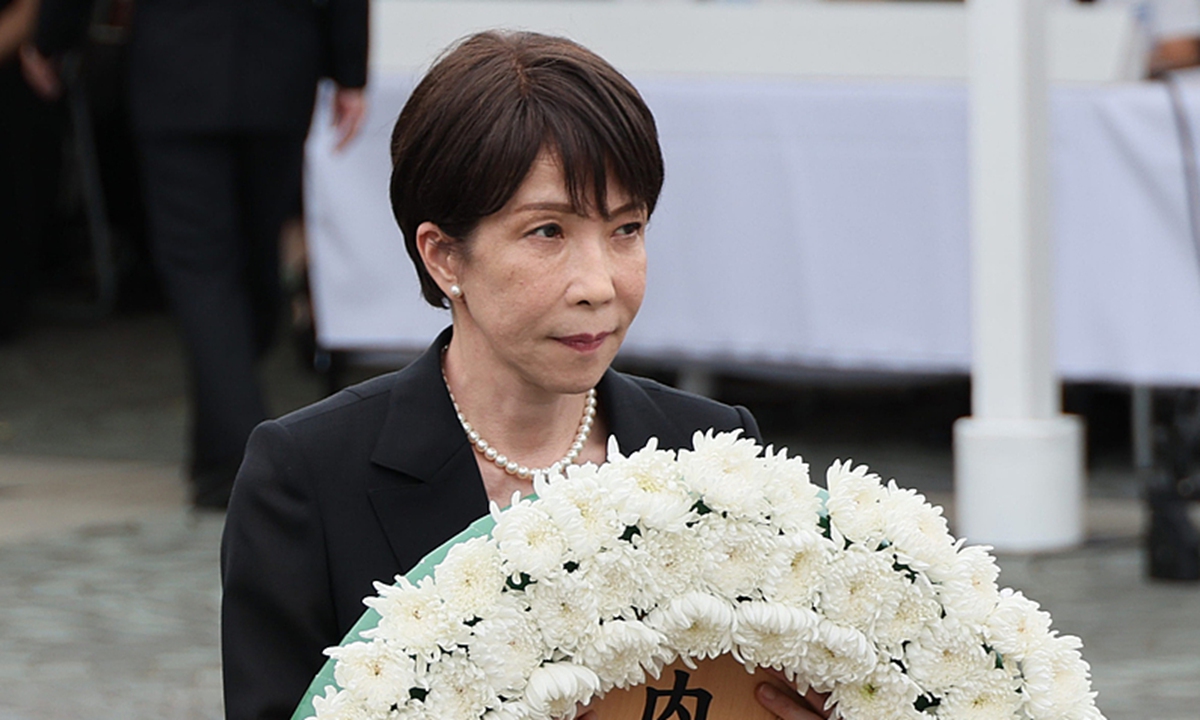
Chinese experts noted that, similar to her ambiguous remarks at the memorial ceremony in Hiroshima, Takaichi stopped short of making a clear commitment to maintaining the Three Non-Nuclear Principles in the future, as her government's stance on nuclear issues has sparked concern and anger among the Japanese public. They also warned that, given Japan's lack of thorough reflection on its wartime aggression, Tokyo's moves to dilute the Three Non-Nuclear Principles should raise alarm across the international community.
"Our country firmly upholds the three non-nuclear principles, and under the pledge that 'Nagasaki shall be the last city to suffer a nuclear attack,' we are promoting realistic and practical initiatives toward the realization of a world without nuclear weapons," Takaichi claimed, according to the Japan Times.
But unlike previous prime ministers, many of whom had pledged that Japan would "continue to uphold" the principles, Takaichi merely described the government's current position without making an explicit commitment about the future, per the report.
As Hiroshima observed the 81st anniversary of the US atomic bombing of the city on Thursday, Takaichi also emphasized that Japan pledges to achieve a world free of nuclear weapons while upholding the Three Non-Nuclear Principles, despite Japanese media noting that she has left the door open for future revisions.
Takaichi's remarks in Hiroshima and Nagasaki that Japan upholds the three non-nuclear principles were largely seen as a reaffirmation of the country's existing policy position rather than a pledge to maintain the principles in the future, Liu Jiangyong, a professor at the Institute of International Studies at Tsinghua University, told the Global Times.
Liu said that currently, some Japanese officials' dangerous remarks on nuclear have sparked criticism among Japanese society. He pointed out that Takaichi only referred to Japan's current adherence to the principles, without explicitly committing to preserving them going forward. Her subsequent focus on broader goals such as achieving a "world without nuclear weapons" has further fueled questions over her actual policy intentions.
Japanese Defense Minister Shinjiro Koizumi claimed in an online program released in July that discussions on nuclear weapons were necessary to strengthen Japan's defense capabilities, according to Kyodo News. While acknowledging that the issue was difficult to discuss in Japan, he claimed it was something that "could not be avoided."
Opposition to the Takaichi administration's nuclear-related moves has emerged across Japan, including from local governments, media organizations and civil society groups.
According to statistics from the Japanese Diet, at least 128 local assemblies across the country had submitted written opinions to the central government or parliament between Takaichi's inauguration on October 21 last year and July 28 this year, calling for the country's Three Non-Nuclear Principles to be upheld, according to Xinhua News Agency.
In an interview with the AFP, 82-year-old Satoshi Tanaka, a campaigner who survived the 1945 attack on Hiroshima expressed frustration that current political leaders like Takaichi are focusing on military capacity at the expense of diplomacy.
"There is so much talk about national security. What about building peace through diplomacy?" he said.
Responding to a question concerning the Japanese authorities are rebuilding Japan's war machine, seeking to revise the Three Non-Nuclear Principles, and pursuing nuclear sharing with the US, even the possession of nuclear weapons, Chinese Foreign Ministry spokesperson Lin Jian said on Thursday that the devastation and tragedies brought by nuclear weapons should never repeat themselves. That said, the particular context of the nuclear explosions should all the more be remembered and the lessons of Japanese militarism's aggression and expansion must forever serve as an alarm.
The Tokyo's moves on nuclear policy have also raised concerns in the international community.
Russia considers the rhetoric of Japanese authorities regarding the need for Japan to revise its Three Non-Nuclear Principles provocative and unacceptable, Russian Ambassador to Japan Nikolai Nozdrev said in an interview with RIA Novosti, which was published on Saturday.
Responding to Koizumi's remarks on nuclear discussion, Nozdrev said "This is the first time in Japan's history, as the only country to have suffered atomic bombings in Hiroshima and Nagasaki, that a sitting defense minister has publicly called for lifting the 'taboo' on discussions related to nuclear weapons. We consider such rhetoric from official Tokyo provocative and absolutely unacceptable."
Japan has yet to fully reckon with its wartime aggression, thus any attempt by Tokyo to move toward acquiring nuclear weapons could pose serious risks to regional peace and global security, Lü Chao, an expert on the Korean Peninsula issue at the Liaoning Academy of Social Sciences, told the Global Times.
Such concerns have become more pronounced as Japan increasingly portrays China as a major security challenge while highlighting perceived threats from other countries, against such a backdrop, any further steps to dilute the three non-nuclear principles are likely to heighten concerns internationally, particularly among countries that suffered from Japanese aggression during World War II, said Lü.
。 (ECNS) -- Shenyang in northeast China’s Liaoning Province launched two cross-border transport routes simultaneously for the first time on Wednesday, namely, Shenyang-Baku (Azerbaijan), and Shenyang-Mongolia-Russia. On the day, a batch of locally produced frozen beverages cleared customs and underwent inspection under local customs supervision before being loaded onto TIR (Transports Internationaux Routiers) trucks bound for Baku. The route departs from the TIR Shenyang Consolidation Center, exits China via Baketu Port in Uygur Autonomous Region, and reaches Kuryk Port in Kazakhstan, where cargo is ferried across the Caspian Sea to Baku Port. Compared with the traditional path, the new route takes around 13 or 14 days for the whole journey, mitigating constraints brought by geopolitical conditions and extreme weather. Also on Wednesday, four trucks loaded with auto spare parts set off from the TIR Shenyang Consolidation Center. They will cross Mongolia through Erenhot Port in Inner Mongolia to Russia. The TIR Shenyang Consolidation Center has opened more than 10 cross-border routes covering six countries, including Russia, Belarus, Mongolia, Kazakhstan, Uzbekistan and Azerbaijan. It has dispatched 480 TIR truck trips in total, with cumulative cargo value standing at 272 million yuan (approximately $40.42 million). (By Intern Xu Wenda, Zhang Dongfang)

 。
。Current article:http://o5h1n.xuebenwagangqingre.buzz/sdnnoka/20260826/3630.html
Published on:06:32:02
 有色板块拉升,金诚信、精艺股份涨停
 不惧背叛质疑 美媒盛赞威少:史上唯一三双先生
 “可以从外面带吃的(但要给老板尝尝)”无锡一餐厅超长店规标语走红,老板:有网友专程来打卡,还有社牛顾客请自己品尝自带美食
 French rider Valentin Debise’s Chongqing 'Landing Visa' ride puts mountain city in global spotlight
 《使命召唤21:黑色行动6: Modern Warfare 4》为幽灵等特定角色新增全新动态外观选项
 强生:IMAAVY获FDA批准用于治疗罕见血液疾病
 18.9万人爆仓!比特币狂飙 本周累涨超24% 创2023年3月以来最大单周涨幅
 路径有变!强台风“沙德尔”登陆浙江概率上升,温州、台州、丽水局地将有特大暴雨,杭州风雨最强时段集中在这天
 “洪水爆发后才放上几个沙袋”,美财长最新努力失败了!
 藏在华强北深处的“奢侈品帝国”
 专家:勃利东北虎或为捕捉家畜进村,成年虎能轻松扑倒一头牛
 字母哥:在迈阿密故事结束后 肯定会回到密尔沃基